Sitr
A real-time seating platform for events where the chart actually matters — built so guests pick their own seats and the organizer stops being the middleman.
Visit usesitr.comAttendees seated
1,000+
Guest logins
None required
Event setup
About 2 minutes
usesitr.com — the launch site
The Problem
The spreadsheet was never really the problem.
At a banquet or a gala, the seating chart is politics. Who sits with their cohort, who is near the front, who cancels the morning of. The organizer builds it in a spreadsheet because that's what's at hand — and then spends two weeks as a human router, taking requests by text and re-exporting a file that is stale the moment it prints.
Replacing the spreadsheet with a nicer spreadsheet fixes nothing. The bottleneck is that every change has to pass through one person. Sitr's premise is to remove that person from the loop entirely: let guests choose, and let the chart maintain itself.
Which leaves the site with a persuasion problem. Anyone who has run one of these events has a specific fear about handing seats to guests, and it has to be answered before they will read anything else.
The Approach
Name the pain in five words, then hand them the room.
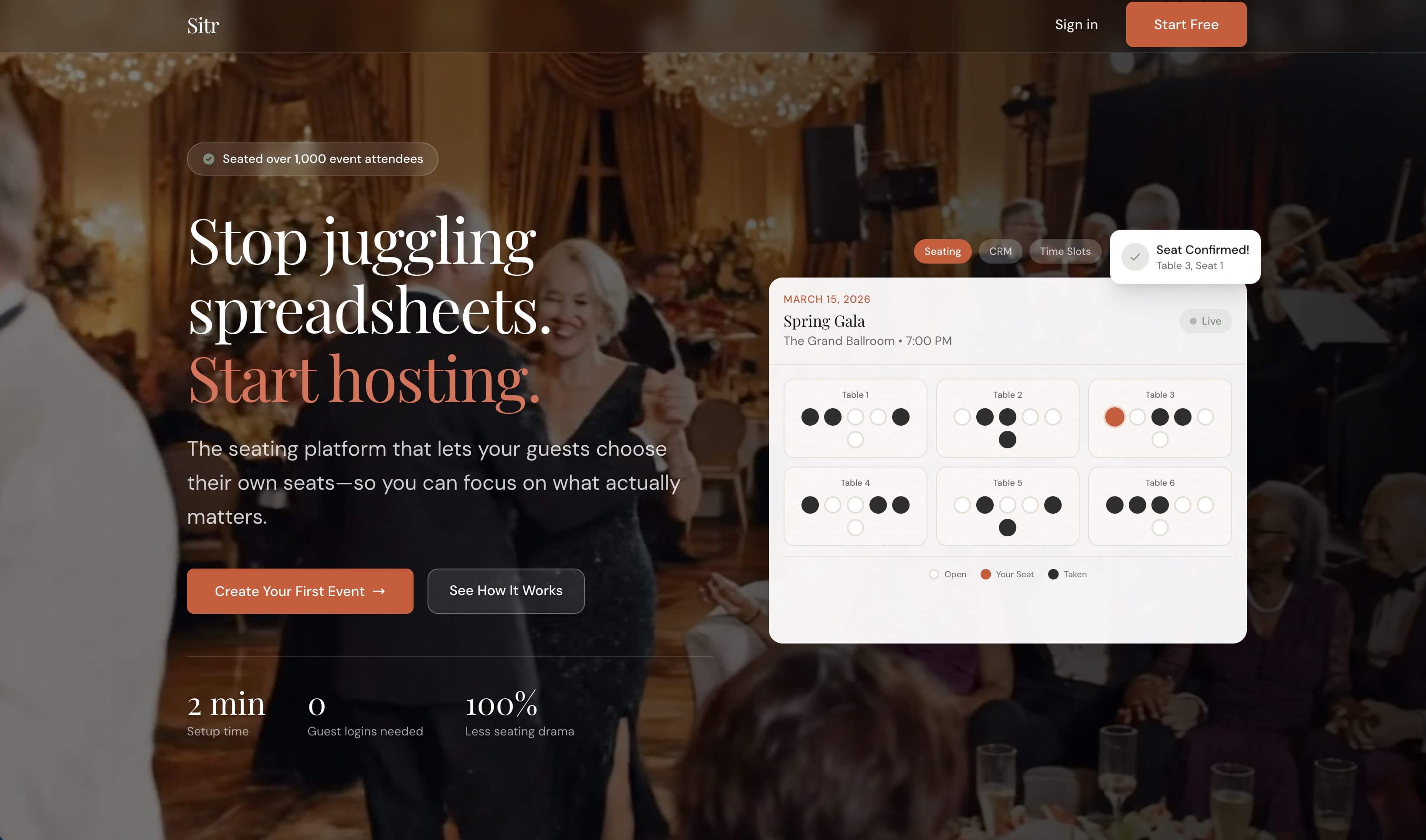
Stop juggling spreadsheets. Start hosting. is the before and after of the job, in the words a host would use. No category noun, no feature — the sentence works whether or not you have ever heard of the product.
The objection gets answered above the fold, disguised as a statistic. Zero guest logins neededsits between setup time and less seating drama, because “will my guests have to make an account” is the first thing a host thinks and the fastest way to lose them.
And the product isn't described, it's shown: a live seat map floating over a real ballroom, mid-event, with a confirmation landing in the corner. Software and occasion in one frame. You know what it does and what it's for before you read a word.
The Mechanic
The whole product is one tap.
A guest gets a link, sees what's open, and taps a chair. No account, no app, no reply-all. The organizer watches the room fill instead of maintaining it.
The hard part is the second half of that sentence: two guests reaching for the same chair at the same moment. The map is live, so a seat is gone the instant someone takes it — which is exactly the thing a shared spreadsheet cannot promise.
The map below is that interface, rebuilt on this page. Take a seat — and notice the room filling around you while you decide.
March 15, 2026
Spring Gala
The Grand Ballroom • 7:00 PM
Table 1
Table 2
Table 3
Table 4
Table 5
Table 6
Other guests are picking while you decide.
The Workflow It Replaces
Before — the spreadsheet
- 1Build the chart by hand in a spreadsheet
- 2Field seat requests by text and email
- 3Re-edit, re-export, reprint
- 4Handle swaps at the door on the night
- 5Hope the printed copy is the current one
After — one link
- 1Create the event — about two minutes
- 2Share one link with the guest list
- 3Guests pick their own seats, no account
- 4The chart updates live for everyone
- 5Walk in with the room already seated
The System
Closer to an invitation than a dashboard.
The display face is a high-contrast serif, set large and spaced like stationery — the register of the event itself, not of event software. Everything operational drops into a plain sans, so the interface never competes with the room.
Terracotta is the only saturated color, and it means one thing: this is yours, or this is the action. Seats you can't have are ink. Sage carries status — live, confirmed — so a glance at the map tells you where you stand without reading the key twice.
Ink
#1D1B1C
Headlines, taken seats
Terracotta
#C45D3C
Primary action, your seat
Clay
#D4745B
Display accent
Sage
#7E8B7A
Live status, confirmations
Cream
#F5F3F0
Product surface
Sand
#E3DED6
Open seats, rules
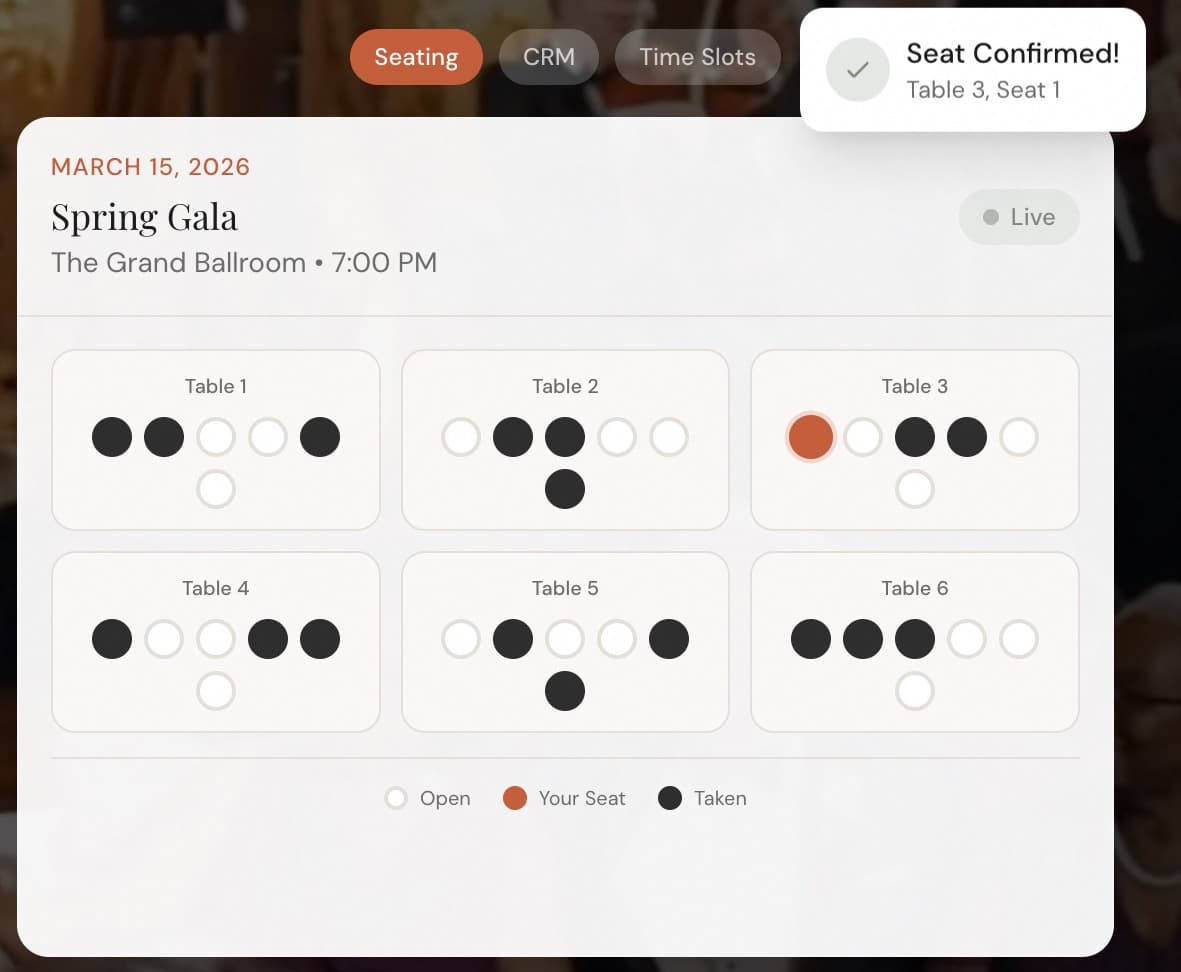
Six tables, three seat states, one confirmation
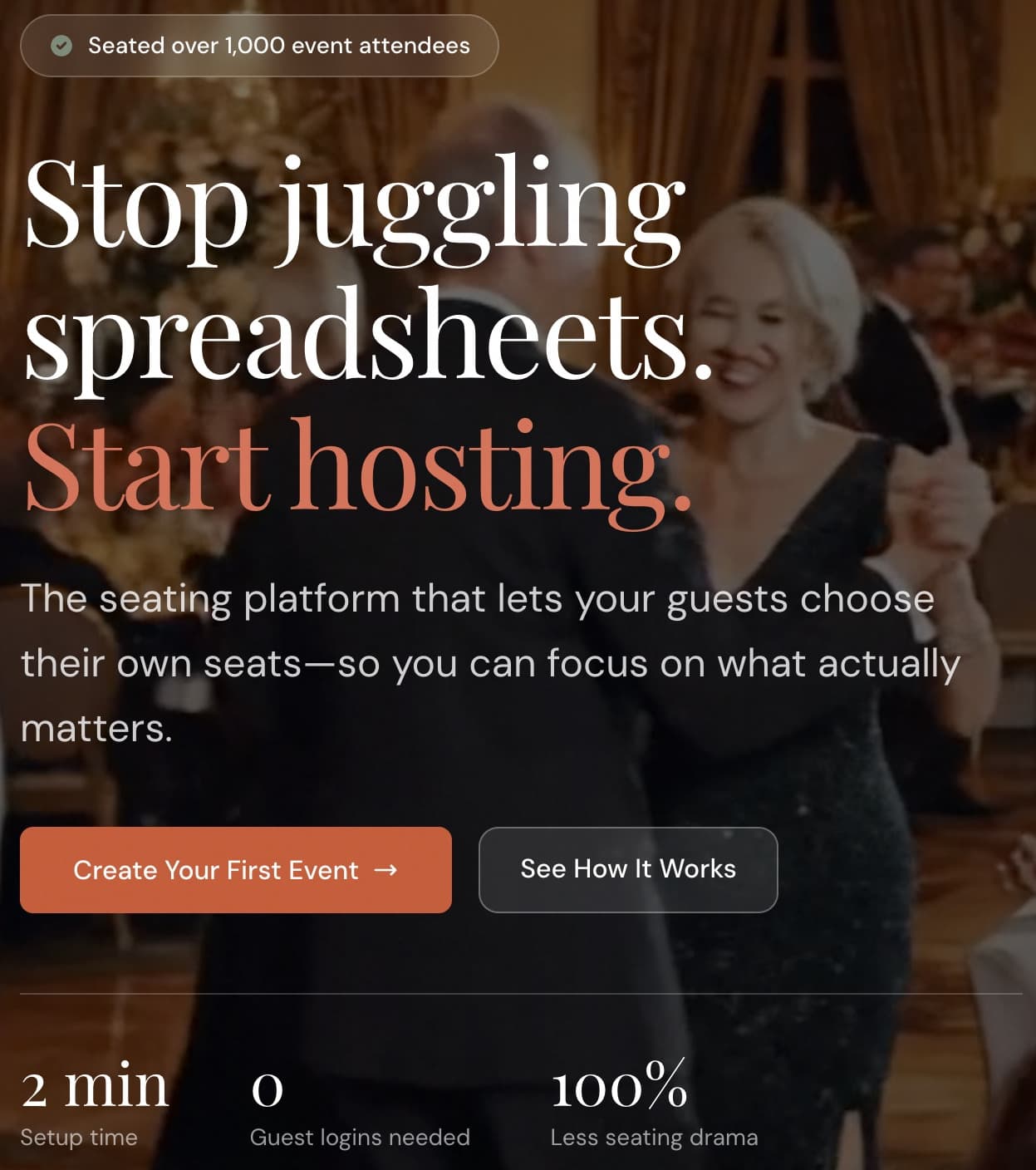
Above the fold
Every line answers a question the host is already asking.
- Has anyone actually used this?
- Seated over 1,000 event attendees — the badge, before the headline
- What is this for?
- Stop juggling spreadsheets. Start hosting.
- What does it do, exactly?
- Guests choose their own seats — so you can focus on what actually matters
- How much work is this for me?
- 2 min setup · 0 guest logins · 100% less seating drama
What Was Built
A launch surface that seats you before you sign up.
The site borrows the product's own interface for its hero, so the first thing a visitor sees is the thing they will actually use — not an illustration of it.
- Positioning and messaging for the launch
- Marketing site design and build
- Seat map as the hero demonstration
- Interface system carried from product to web
- Event photography direction and treatment
- Responsive build, mobile-first
The Result
Over 1,000 attendees seated, none of whom made an account.
The platform now runs the seating for medical school events at scale — the same events that used to be held together by a spreadsheet and one very patient organizer. The pitch survives contact with the room: guests pick, the chart holds, and nobody needed to be taught how.
Next
If the product is simple, the site should prove it in one tap.