Byline
An AI writing tool sold to the people most tired of AI writing — positioned on a visible process rather than another promise about quality.
Visit bylineblogs.comPipeline
6 specialized agents
Promise
Doesn't read like AI
Proof
The process, on screen
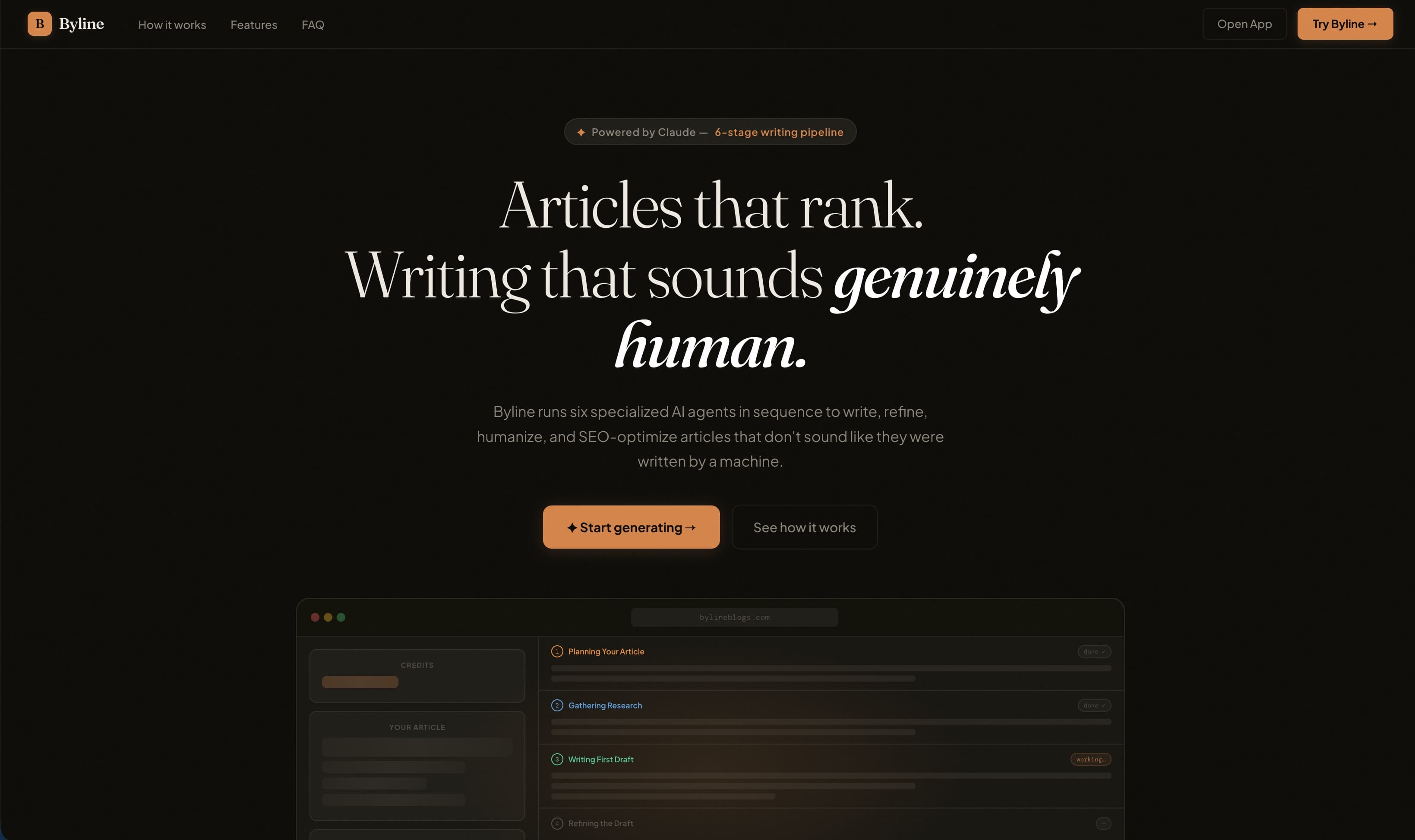
bylineblogs.com — the launch site
The Problem
“AI writing tool” is a negative signal now.
Two years ago the category sold itself. Today the buyer has read enough machine-written copy to recognize it in a sentence, and the phrase arrives pre-loaded with everything they don't want: filler, hedging, that flat competent voice.
So the usual pitch — faster, cheaper, at scale — actively hurts. The more volume a tool promises, the more the buyer hears slop. And a claim like “our output sounds human” is worth nothing, because every tool in the category says it.
Which leaves one honest move: stop asserting the outcome and show the method.
The Approach
Sell the process, and let the design carry the taste.
The headline splits the promise in two. Articles that rank. is the business outcome; Writing that sounds genuinely human. is the fear being answered — and it lands in italic, because the emphasis is the whole point.
Directly beneath it, the mechanism, counted: six specialized agents in sequence. A number is a commitment. It implies stages you can name, which is why the badge at the top of the page says 6-stage writing pipeline rather than “advanced AI.”
Then the design does the part copy can't. A literary serif on near-black, warm amber, generous space — the visual register of a magazine rather than a generative-AI startup. A page about writing has to look like it was made by someone who reads.
The Mechanic
Six passes you can watch happen.
One model writing one draft in one pass is exactly what the buyer is afraid of. Six named stages — planning, research, drafting, refining, humanizing, optimizing — describe a process a person would recognize as editing.
So the stages became the product's primary interface, not a progress spinner. You see the pipeline while it runs, which converts a claim into an observation. It also sets an expectation the tool can meet: this takes a minute, because it is doing six things.
That panel, rebuilt here. Run it and watch the stages resolve one at a time.
- 1Planning Your Article
Outline, angle, target reader
- 2Gathering Research
Sources and supporting detail
- 3Writing First Draft
The full piece, start to finish
- 4Refining the Draft
Structure, cuts, transitions
- 5Humanizing the Voice
Cadence, idiom, the tells removed
- 6Optimizing for Search
Headings, terms, metadata
The Shift
What the category says
- 10x your content output
- Blog posts in 30 seconds
- Powered by advanced AI
- Sounds human, we promise
- Unlimited articles, one price
What Byline says
- Articles that rank
- Six specialized agents, in sequence
- Write, refine, humanize, optimize
- You watch each stage run
- Writing that sounds genuinely human
Same product category, opposite posture. The left column sells volume to someone worried about quality; the right sells method to someone worried about voice.
The System
Made by someone who reads.
Nearly every tool in this category ships the same look: violet gradient, geometric sans, a sparkle icon. Matching it would have put Byline in the pile it is arguing against.
Instead: a high-contrast literary serif with a true italic, paper cream on near-black, and amber as the only saturated color. The stage colors are the one place the palette opens up — each pass gets its own hue so the pipeline reads as a sequence of different work rather than one long load.
Ink black
#100F0B
Page ground
Paper cream
#ECE8DF
Display type
Amber
#D4854C
Primary action
Slate blue
#7C9BB8
Research stage
Sage
#6FB994
Drafting stage
Warm gray
#88857E
Body copy
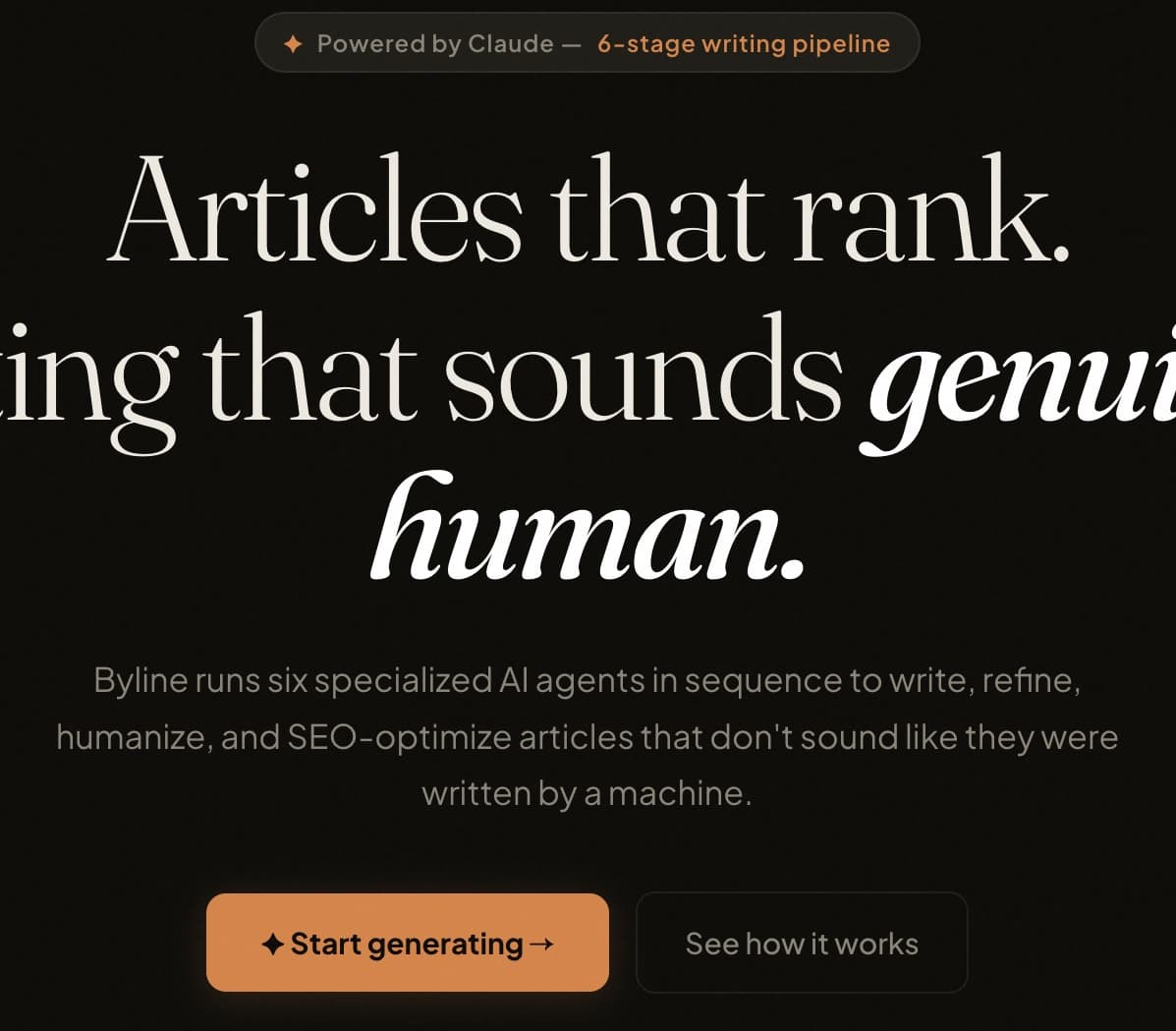
Badge, promise, mechanism, action — in that order
What Was Built
A page that argues by showing its work.
The site and the product share one visual language, so the pipeline a visitor watches on the homepage is the same one they meet after signing up.
- Positioning against the AI-slop objection
- Marketing site design and build
- Naming and sequencing of the six stages
- Pipeline UI as the hero demonstration
- How it works, features, FAQ
- Responsive build, mobile-first
The Result
A tool in a distrusted category, with a reason to be trusted.
Byline ships with the least defensible claim in software — that its writing doesn't sound like software wrote it — and answers it the only way that works: by naming the six things it does and letting you watch them happen. The site earns the benefit of the doubt that the category has spent.
Next
When nobody believes the claim, show the method.